
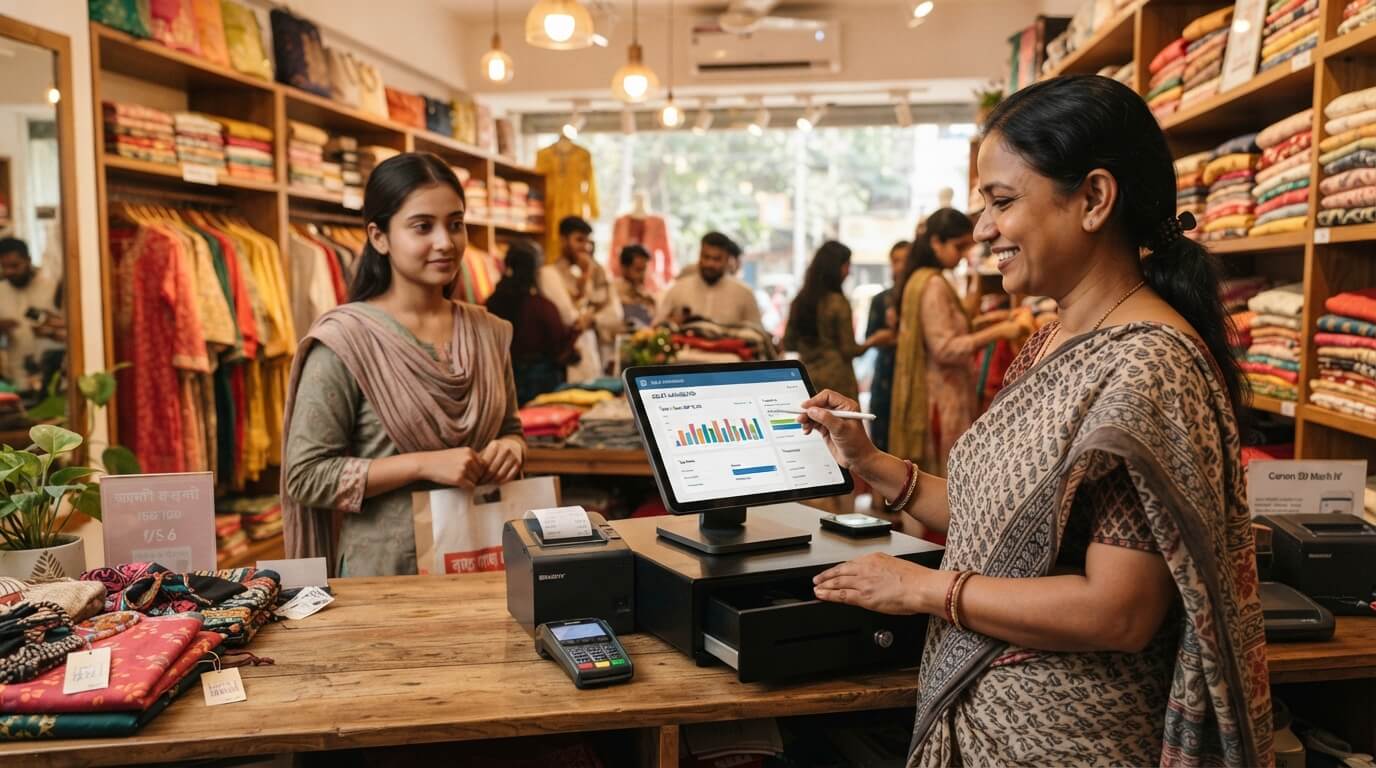
Introduction
Choosing the right POS solution for businesses in South Asia is one of the more practical decisions a retailer, restaurant owner, or distributor can make. Markets in Bangladesh, India, Pakistan, Sri Lanka, and Nepal each have their own tax rules, payment habits, and connectivity conditions, so a POS solution for businesses in South Asia has to handle more than basic billing. It needs to work with local mobile wallets, print VAT-ready receipts, and keep running when the internet drops.
This article looks at what a POS solution for businesses in South Asia typically includes, how the market has developed, what to check before signing a contract, and where common software options fit different business types. Whether the goal is a full retail management software South Asia setup for a multi-branch chain or a simple mobile POS system for a single counter, the checks are largely the same. The goal here is to give a clear, fact-based picture rather than a sales pitch for any single product.
Why a POS Solution Matters for South Asian Businesses
Retail in South Asia is shifting from paper ledgers and manual cash registers to digital billing. In India, the Asia Pacific point-of-sale market was valued at USD 13.57 billion in 2025, about 35.2% of the global total, and is projected to reach close to USD 16 billion in 2026 as businesses replace manual systems. Mobile and portable POS devices already account for a large share of new deployments in India, with portable units holding 62.15% of the India POS terminals market in 2025.
In Bangladesh, VAT-registered businesses are expected to keep proper digital sales records for NBR reporting, which is one reason a VAT-compliant POS is often built around Mushak-ready reports rather than generic billing, and why a POS solution for businesses in South Asia in this market usually leads with tax compliance. In India, mandatory electronic invoicing now applies to companies crossing a turnover threshold, pushing many retailers toward POS software that can generate invoices through the government portal at the time of sale rather than after the fact.
Digital payment habits also shape what a POS solution for businesses in South Asia needs to support. In Bangladesh, bKash and Nagad are used for everyday retail payments, so local POS vendors build in direct integration with these wallets — retailers searching for POS software with bKash and Nagad payment support are usually looking for exactly this kind of built-in wallet integration rather than a manual workaround. In India, UPI has grown far faster than physical POS terminal deployment — by February 2025, merchants had installed 352 million UPI QR codes compared with only 8.9 million POS terminals — meaning software that can reconcile QR-based and card-based payments in one report has practical value.
What a POS Solution for Businesses in South Asia Should Include
Not every POS product on the market covers the same ground. Based on how vendors in the region describe their own systems, a POS solution for businesses in South Asia commonly includes:
- Billing and barcode scanning — quick checkout using barcodes, PLU codes, or item tiles.
- Inventory tracking — real-time stock counts, batch and expiry tracking for pharmacies and grocery stores, and low-stock alerts.
- Multi-branch management — a single dashboard showing sales and stock across more than one outlet, with stock transfer between branches.
- VAT or GST compliance — automatic tax calculation and report generation matching local rules (Mushak in Bangladesh, GST in India).
- Offline billing — the ability to keep billing during an internet outage, with data syncing once the connection returns.
- Local payment integration — support for bKash, Nagad, UPI, or card payments depending on the country.
- Reporting — daily sales summaries, profit and loss views, and staff-level performance tracking.
A retailer evaluating a POS solution for businesses in South Asia should treat this list as a baseline checklist, then add sector-specific needs such as table management for restaurants or prescription tracking for pharmacies.
Country-by-Country Considerations
Bangladesh
Several vendors sell POS software Bangladesh retailers use directly, including Vitepos, NogorPOS, and smaller regional providers such as Shohoz Software and E-Hishab. Most of these are offered as a cloud-based POS system with a monthly fee rather than a one-time license. A POS solution for businesses in South Asia operating in Bangladesh typically needs Bangla-language support, Mushak-ready VAT output, and bKash/Nagad payment handling, since these are standard requests from local retailers, pharmacies, and super shops.
India
India’s POS terminal market is shaped by regulation as much as by demand. RBI Payment Aggregator rules raised net-worth thresholds and required security audits, which has pushed smaller aggregators toward partnerships with larger, capitalized players. Government programs such as the Payments Infrastructure Development Fund have subsidized terminal deployment in smaller towns, with certified encryption and remote key injection required for these devices. Any POS solution for businesses in South Asia sold into the Indian market now generally needs GST reporting and UPI reconciliation built in, not added later.
Sri Lanka, Pakistan, and Nepal
Cloud-based POS system providers such as POS Masters serve Sri Lankan retail, restaurant, and service businesses with subscription pricing rather than one-time software purchases. Across Pakistan and Nepal, POS adoption follows a similar pattern to Bangladesh — small and medium retailers moving from manual registers to basic digital billing first, then adding inventory and multi-branch features as the business grows. A POS solution for businesses in South Asia that works well in one of these smaller markets is often the same core software used in Bangladesh or India, adjusted for local tax rules and currency.
POS Software for Small Businesses and Restaurants
Not every business needs a full ERP-style system on day one. A large share of the demand for a POS solution for businesses in South Asia comes from single-outlet shops and small restaurants that just need reliable billing and basic stock control. For these owners, the search usually starts with affordable POS software for small business in South Asia rather than an enterprise package with modules they will not use for years.
The best POS software for small retail shops in Bangladesh tends to share a few traits: a simple Bangla-language interface, bKash/Nagad payment acceptance, and pricing that does not require a large upfront investment. Grocery stalls, tailoring shops, and mobile phone accessory shops in cities like Dhaka, Chittagong, and Sylhet commonly start with this type of lightweight setup, then add inventory and reporting features as sales volume grows.
Restaurants have a slightly different list of requirements. A cloud POS system for restaurants in South Asia generally needs table management, kitchen order tracking, and menu-level sales reporting in addition to standard billing. Cloud-based POS system options are common here because they let an owner check daily sales from a phone without visiting the restaurant, and because software updates and menu changes can be pushed centrally rather than store by store.
Common POS Software Options Used in the Region
A number of products are used by businesses looking for a POS solution for businesses in South Asia. This is a factual overview, not a ranking:
- Vitepos — Vitepos is a powerful WooCommerce POS plugin that transforms your WordPress store into a complete point-of-sale system for retail shops, grocery stores, restaurants, and cafes with real-time inventory and order synchronization. It can be use it any country.
- PridePOS (Pridesys IT) — a cloud-based POS aimed at retail stores, supermarkets, pharmacies, and restaurants in Bangladesh, with barcode billing, ERP integration, and multi-branch support.
- Managerium Retail ERP (AKIJ iBOS) — combines POS with inventory, accounting, CRM, and HR modules in one cloud platform for multi-branch retailers.
- Odoo POS — part of the wider Odoo ERP system, used across South Asia by retail, restaurant, and SME businesses that also need accounting and e-commerce integration.
- Shopify POS — used mainly by merchants who sell both online and in-store and want unified inventory across both channels.
- HDPOS Smart, Vyapar, and TallyPrime — commonly used in India for retail billing, GST compliance, and accounting, with TallyPrime reporting close to 2 million businesses using its broader software.
- POS Masters — a Sri Lanka-based cloud POS provider offering retail, restaurant, and service-industry modules on a monthly or annual subscription.
Pricing models vary by vendor. Some charge a one-time license fee, others use monthly subscriptions (Sri Lankan cloud POS providers, for example, list plans in the range of a few thousand rupees per month), and enterprise-grade systems are priced according to the number of branches and modules used.
How to Choose a POS Solution for Businesses in South Asia
Selecting a POS solution for businesses in South Asia comes down to matching the software to the specific type and size of business, rather than picking the most advertised name. Business owners searching for how to choose a POS system for multi-branch retail usually run into the same set of questions, so it helps to work through them in order rather than comparing feature lists side by side. A practical way to narrow the list:
- Define the business type. A single grocery stall has different needs from a five-branch clothing chain. Pharmacies need expiry and batch tracking that a generic retail POS may not include.
- Check payment integration. If bKash or Nagad acceptance matters in Bangladesh, or UPI reconciliation matters in India, confirm the POS solution supports it directly rather than through a third-party workaround. Retailers specifically looking for POS software with bKash and Nagad payment support should ask for a live demo of wallet reconciliation before signing up, not just a features list.
- Confirm tax compliance. Ask whether the software generates Mushak reports (Bangladesh) or GST/e-invoice reports (India) in the format tax authorities require.
- Test offline functionality. Power and internet interruptions are common in parts of the region, so billing should continue offline and sync automatically once connectivity returns.
- Review multi-branch reporting. For businesses with more than one location, check whether stock transfers, centralized reporting, and staff permissions are handled in a single dashboard. This is the core of how to choose a POS system for multi-branch retail correctly — the dashboard, not the checkout screen, is what determines whether the system scales.
- Ask about local support. Response time for troubleshooting matters more for daily operations than a long features list.
- Compare pricing against business size. A one-person shop rarely needs the same package as a five-branch chain, so ask vendors for a pricing tier that matches current store count rather than committing to the largest plan up front.
Challenges Businesses Face When Adopting POS Systems
A few challenges are documented in market data rather than assumed. In India, the removal of merchant discount rates on UPI reduced the subsidy revenue that acquirers previously used to offset POS device rental costs, which slowed deployment to very small merchants. At the same time, QR code payment methods have expanded far faster than physical POS terminal installation, creating a gap that a POS solution for businesses in South Asia has to bridge through software-side reconciliation rather than new hardware. In Bangladesh, VAT compliance requirements mean that businesses using outdated billing methods risk reporting errors that a properly configured POS solution for businesses in South Asia is designed to prevent.
Across the region, businesses that delay adopting any retail management software South Asia option tend to run into the same problems: mismatched stock counts, manual VAT calculation errors, and no clear record of which branch is underperforming. None of this is unique to one country — it shows up in surveys of small retailers in Dhaka, Colombo, and tier-2 Indian cities alike, which is part of why demand for even a basic mobile POS system continues to grow across South Asia rather than being limited to large cities.
Conclusion
A POS solution for businesses in South Asia is not a single product but a category that ranges from simple billing apps for one-person shops to full ERP-integrated platforms for multi-branch retail chains. The right choice depends on business type, local tax rules, the payment methods customers use, and whether operations need to continue offline. Bangladesh, India, Sri Lanka, Pakistan, and Nepal each have distinct requirements, but the underlying decision process — checking tax compliance, payment integration, offline support, and local service response — stays largely the same across the region.
Frequently Asked Questions
It is billing and retail management software built or adapted for local conditions in countries like Bangladesh, India, Pakistan, Sri Lanka, and Nepal, including tax compliance, mobile wallet payments, and offline billing.
POS software is not legally mandatory for every business, but VAT-registered businesses need proper sales records, and Mushak-ready POS reports help meet NBR requirements.
Many systems built for the region support offline billing, with transactions syncing automatically once the internet connection is restored.
Yes. Several systems used in Bangladesh, India, and Sri Lanka support centralized multi-branch billing, stock transfer, and reporting from a single dashboard.
Depending on the country, common integrations include bKash and Nagad in Bangladesh, UPI and card payments in India, and standard card processing in Sri Lanka and Pakistan.
Pricing varies by vendor and business size — some charge a one-time license fee, while cloud-based providers commonly use monthly or annual subscriptions.
Subscribe
To get news about new releases, Updates, Blog Post, Deals and Discounts

